As in previous examples, the concern here will not be with the data to be placed in the tree, but with the mechanism for implementing the tree structure itself. This can be done in the same semi-generic fashion as in other examples in the text. Since there is already on hand (in the form of the module Countries) a suitable data type, the module here is called CountryBinaryTree. The usual minor renaming is needed to use any other ADT in the place of Country.
In this version, the three kinds of traverse are distinguished via an enumeration, a parameter of which type must be passed to determine which traverse to perform with the procedure acting on the data items.
DEFINITION MODULE CountryBinaryTree;

(* semi-generic tree type
by R. Sutcliffe   last modified 1995 06 07 *)

FROM Countries IMPORT
  Country, KeyType, ActionProc;

TYPE
  DataType = Country; (* change this line and import as needed *)
  TreeState = (allRight, empty, entreeFailed, notFound, bad);
  BinaryTree;  (* opaque type *)
  TraverseOrder = (in, pre, post);

PROCEDURE TreeStatus (t : BinaryTree) : TreeState;
(* Pre : t is a valid initialized table
   Post : The State of the tree is returned *)

PROCEDURE Create (VAR t : BinaryTree);
(* Pre : none
   Post : t is a newly created empty tree.*)

PROCEDURE Insert (t : BinaryTree; data : DataType);
(* Pre : t is a valid initialized tree
   Post : memory is obtained and data has been entreed in the proper place for a binary tree using the ADT compare procedure and the state of the tree is allRight or the entreeing failed and the state is entreeFailed. *)

PROCEDURE Fetch (t : BinaryTree; key : KeyType; VAR data : DataType);
(* Pre : t is a valid initialized tree
   Post : data matching key is returned in data and the state of the tree is allRight or the fetch failed and the state is notFound. *)

PROCEDURE Update (t : BinaryTree; data : DataType);
(* Pre : t is a valid initialized tree
   Post : data matching the key of the data is updated in the tree and the state of the tree is allRight or the update failed and the state is notFound. *)

PROCEDURE Remove (t : BinaryTree; key : KeyType; VAR data : DataType);
(* Pre : t is a valid initialized tree
   Post : data matching key has been removed and returned in data (not disposed of) and the state of the tree is allRight or the removal failed and the state is notFound. *)

PROCEDURE Destroy (VAR t : BinaryTree);
(* Pre : t is a valid initialized tree
   Post : the tree memory is returned and the variable is invalid
   and the memory associated with the items in the tree is removed by calling the ADT module dispose procedure. *)


PROCEDURE Traverse (t : BinaryTree; Proc : ActionProc; order : TraverseOrder);
(* Pre : t is a valid initialized tree
   Post : the table items are traversed in the order given and Proc is performed on each one. *)

END CountryBinaryTree.
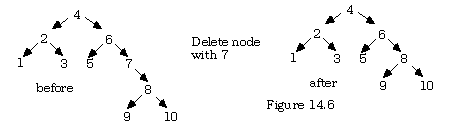
When this was implemented, a number of local procedures were developed, most of which act on nodes rather than on the data in the nodes. Such actions need to be hidden from the outside world, and separating them even from the abstract (and somewhat generic) procedures that handle data is recommended. The reader should note that insertion of new items always takes place at a leaf, but deletion at other than a leaf position is rather complex. If the node to be deleted has only one subtree hanging from it, then that subtree can be drawn up to take its place, as shown in figure 14.6.
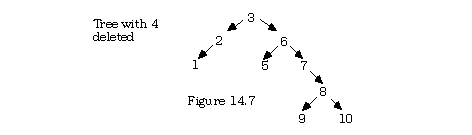
If the deletion is at an interior node (a position with two children), one first finds the predecessor node (in the in order sense, not in the tree structure sense). This node will always be a leaf (why?), and can be found by looking at the left child of the starting node, then going right as far as possible. This predecessor node has its data swapped with the target node, and then the predecessor leaf node is deleted. (This is not the only possible strategy.) For instance, if in the tree on the left of figure 14.6 the node with the data 4 (happens to be the root) were to be deleted, its in order predecessor (go left, then take as many rights as possible) is 3, which is swapped with the 4, and its node deleted, resulting in the structure shown in figure 14.7.
Here is the implementation of the binary tree, with the specific imports for this same data type. To change the implementation, just change the name of this module and of the ADT module being imported from (write it first) appropriately; nothing else needs to be altered.
IMPLEMENTATION MODULE CountryBinaryTree;

(* semi-generic tree type
by R. Sutcliffe   last modified 1995 06 07 *)

FROM Countries IMPORT
  Country, KeyType, ActionProc, Compare, GetKey, Assign, New, Valid, Dispose;
FROM Storage IMPORT
  ALLOCATE, DEALLOCATE;
FROM STextIO IMPORT
  WriteString, WriteLn, WriteChar;
FROM Strings IMPORT
  CompareResults;

TYPE
  NodePointer = POINTER TO TreeNode;
  TreeNode =
    RECORD
      item : DataType;
    leftPoint, rightPoint, parent : NodePointer;
    END;
  BinaryTree = POINTER TO TreeData;
  TreeData =
    RECORD
    root : NodePointer;
    state : TreeState;
  END;
  NodeProc = PROCEDURE (NodePointer);

  (* TreeState = (allRight, empty, entableFailed, notFound, bad); *)

(* Here is a collection of local procs used in this module *)

PROCEDURE MakeNode () : NodePointer;
VAR
  temp : NodePointer;
BEGIN
  NEW (temp); (* get node memory *)
  IF temp # NIL
    THEN
      New (temp^.item);  (* node OK so get data value memory *)
      IF NOT Valid (temp^.item)
        THEN (* failed so return NIL *)
          DISPOSE (temp);
        END;
    END;
  RETURN temp;
END MakeNode;

PROCEDURE InsertNode (VAR root : NodePointer; newNode : NodePointer);
VAR
  point : NodePointer;
  done : BOOLEAN;
BEGIN
  IF root = NIL
  THEN (* first item *)
    root := newNode;
    newNode^.parent := NIL;
  ELSE
    point := root;
    done := FALSE;
    REPEAT
      IF Compare(GetKey(newNode^.item),GetKey (point^.item)) = greater
        THEN
          IF point^.rightPoint = NIL (* at end *)
            THEN
              point^.rightPoint := newNode;
              done := TRUE;
            ELSE
              point := point^.rightPoint
            END; (* if point *)
        ELSE (* less or equal *)
          IF point^.leftPoint = NIL (* at end *)
            THEN
              point^.leftPoint := newNode;
              done := TRUE;
            ELSE
              point := point^.leftPoint
            END; (* if point *)
        END; (* if compare *)
    UNTIL done;
    newNode^.parent := point;
  END; (* if root *)
END InsertNode;

PROCEDURE Find (root : NodePointer; key : KeyType; VAR point : NodePointer);
(* get a pointer to the node belonging to the key. Returns NIL if not found *)
BEGIN
  IF (root = NIL) (* recursion trapdoor *)
      OR  (Compare (key, GetKey (root^.item)) = equal) (* got it *)
    THEN
      point := root;
      RETURN;
    END; (* if root *)
  Find (root^.leftPoint, key, point);
  (* if we get it, we don't want to look to the right at all *)
  IF point = NIL (* not found yet *)
    THEN
      Find (root^.rightPoint, key, point);
    END; (* if point *)
END Find;

PROCEDURE InOrderPredPoint (node: NodePointer) : NodePointer;
  (* Find pointer to Inorder predecessor, i.e. to the rightmost node in left subtree
  Pre: the node has a left child
  Post: a pointer to its in order predecessor leaf is returned *)
VAR
  pred : NodePointer;
BEGIN
  pred := node^.leftPoint; (* one left *)
  WHILE pred^.rightPoint # NIL
    DO  (* go as far right as possible *)
      pred := pred^.rightPoint;
    END; (* while *)
  RETURN pred;
END InOrderPredPoint;

PROCEDURE SwapNodeVal (VAR a, b : NodePointer);
VAR
  temp : DataType;
BEGIN
  temp := a^.item;
  a^.item := b^.item;
  b^.item := temp
END SwapNodeVal;

PROCEDURE Delete (t : BinaryTree; node : NodePointer);
(* delete a node *)
VAR
  temp : NodePointer;
BEGIN
  temp := node;
  IF temp^.leftPoint = NIL
    THEN (* empty left branch *)
      IF temp^.rightPoint = NIL (* I am a leaf *)
        THEN
          IF temp^.parent = NIL (* I am root too *)
            THEN
              t^.root := NIL;
            ELSE (* just leaf *)
              IF temp^.parent^.leftPoint = temp
                THEN
                  temp^.parent^.leftPoint := NIL
                ELSE
                  temp^.parent^.rightPoint := NIL
                END;
            END;
          KillNode (temp);
          RETURN;
        ELSE (* not a leaf so pull up right subtree *)
          node := node^.rightPoint;
          KillNode (temp);
          RETURN;
        END;
    ELSIF temp^.rightPoint = NIL THEN (* empty right branch *)
      node := node^.leftPoint; (* so pull up left subtree *)
      KillNode (temp);
      RETURN;
    ELSE (* no branch empty, find inorder predecessor *)
      temp := InOrderPredPoint (node);
      SwapNodeVal (node, temp);
      Delete (t, temp);   (* recursively remove node swapped *)
  END; (* if *)
END Delete;

PROCEDURE KillNode (VAR node : NodePointer);
(* give back all memory associated with node *)
BEGIN
  IF node # NIL
    THEN
      Dispose (node^.item);
      DISPOSE (node);
    END;
END KillNode;

PROCEDURE Erase (VAR r : NodePointer);
(* Pre: r is the root of a subtree
   Post: recursive post traverse killing all nodes *)
BEGIN
  IF r # NIL
    THEN
       Erase (r^.leftPoint);
       Erase (r^.rightPoint);
      KillNode (r);
    END;
END Erase;

(* end local procs *)

PROCEDURE TreeStatus (t : BinaryTree) : TreeState;
BEGIN
  IF t # NIL
    THEN
      RETURN t^.state;
    ELSE
      RETURN bad;
    END;
END TreeStatus;

PROCEDURE Create (VAR t : BinaryTree);
BEGIN
  NEW (t);
  t^.root := NIL;
  t^.state := empty;
END Create;

PROCEDURE Insert (t : BinaryTree; data : DataType);
VAR
  temp : NodePointer;
  state : TreeState;
BEGIN
  state := TreeStatus (t);
  IF (state = bad) OR (state = entreeFailed)
    THEN
      t^.state := entreeFailed;
      RETURN
    END;
  temp := MakeNode ();  (* status ok so get node memory *)
  IF temp = NIL
    THEN
      t^.state := entreeFailed;
      RETURN
    END;
   (* all OK so put it together *)
  Assign (data, temp^.item); (* move data value in *)
  temp^.leftPoint := NIL;  (* always adding a leaf *)
  temp^.rightPoint := NIL;
  InsertNode (t^.root, temp);
  t^.state := allRight;
END Insert;

PROCEDURE Fetch (t : BinaryTree; key : KeyType; VAR data : DataType);
VAR
  point : NodePointer;
BEGIN
  IF t = NIL
    THEN
      t^.state := bad;
      RETURN
    ELSE
      Find (t^.root, key, point);
      IF point = NIL
        THEN
          t^.state := notFound;
        ELSE
          t^.state := allRight;
          data := point^.item;
        END; (* if point *)
    END; (* if t *)
END Fetch;

PROCEDURE Update (t : BinaryTree; data : DataType);
VAR
  point : NodePointer;
BEGIN
  IF t = NIL
    THEN
      t^.state := notFound;
      RETURN
    ELSE
      Find (t^.root, GetKey (data), point);
      IF point # NIL
        THEN
          t^.state := allRight;
          point^.item := data;
        END;
    END;
END Update;

PROCEDURE Remove (t : BinaryTree; key : KeyType; VAR data : DataType);
VAR
  point : NodePointer;
BEGIN
  IF t = NIL
    THEN
      t^.state := bad;
      RETURN
    ELSE
      Find (t^.root, key, point);
      IF point = NIL
        THEN
          t^.state := notFound;
        ELSE
          t^.state := allRight;
          data := point^.item;
          Delete (t, point);
        END;
    END;
END Remove;

PROCEDURE Destroy (VAR t : BinaryTree);
BEGIN
  Erase (t^.root);  (* all nodes *)
  DISPOSE (t); (* tree data *)
END Destroy;

(* local procs: three ways to traverse a sub-tree *)

PROCEDURE InTraverse (r : NodePointer; Proc : ActionProc);
BEGIN
  IF r = NIL  (* recursion trap door *)
    THEN
      RETURN
    END;
  InTraverse (r^.leftPoint, Proc);
  Proc (r^.item);
  InTraverse (r^.rightPoint, Proc);
END InTraverse;

PROCEDURE PreTraverse (r : NodePointer; Proc : ActionProc);
BEGIN
  IF r = NIL  (* recursion trap door *)
    THEN
      RETURN
    END;
  Proc (r^.item);
  PreTraverse (r^.leftPoint, Proc);
  PreTraverse (r^.rightPoint, Proc);
END PreTraverse;

PROCEDURE PostTraverse (r : NodePointer; Proc : ActionProc);
BEGIN
  IF r = NIL  (* recursion trap door *)
    THEN
      RETURN
    END;
  PostTraverse (r^.leftPoint, Proc);
  PostTraverse (r^.rightPoint, Proc);
  Proc (r^.item);
END PostTraverse;

(* end local procs *)

PROCEDURE Traverse (t : BinaryTree; Proc : ActionProc; order : TraverseOrder);
BEGIN
  IF t = NIL
    THEN
      RETURN
    END;
  CASE order OF
    in:
    InTraverse (t^.root, Proc) |
    pre:
    PreTraverse (t^.root, Proc) |
    post:
    PostTraverse (t^.root, Proc)
  END;
END Traverse;

END CountryBinaryTree.
As before, a simple test harness is provided. In order to ensure that all aspects of the library were tested, it contains (in, pre, and post) procedures to traverse the tree and to write out enough of the data from the items being entreed to ensure that the structure is correctly maintained.
This module is in the style favoured by some that employs only unqualified import. As can readily be seen, such a style tends to become cumbersome as the module names grow.
MODULE TestCountryBinaryTree;

(* program to test the logic of the Tree library with countries and their gnp
by R. Sutcliffe   modified 1995 06 01 *)

IMPORT
  Countries, CountryBinaryTree, STextIO, SWholeIO;

VAR
  Tree : CountryBinaryTree.BinaryTree;
  country, fetched : Countries.Country;
  str : Countries.KeyType;
  num : Countries.FieldType;
  gotIt : BOOLEAN;

PROCEDURE WriteCountryName (c : Countries.Country);
BEGIN
  STextIO.WriteString (Countries.GetKey (c));
  STextIO.WriteChar (" ");
END WriteCountryName;

PROCEDURE WriteTree;  (* all data *)
BEGIN
  CountryBinaryTree.Traverse (Tree, Countries.WriteCountryData, CountryBinaryTree.in);
END WriteTree;

(* these three just write the names *)

PROCEDURE WriteTreeIn;
BEGIN
  CountryBinaryTree.Traverse (Tree, WriteCountryName, CountryBinaryTree.in);
END WriteTreeIn;

PROCEDURE WriteTreePre;
BEGIN
  CountryBinaryTree.Traverse (Tree, WriteCountryName, CountryBinaryTree.pre);
END WriteTreePre;

PROCEDURE WriteTreePost;
BEGIN
  CountryBinaryTree.Traverse (Tree, WriteCountryName, CountryBinaryTree.post);
END WriteTreePost;

PROCEDURE WriteTreeAll;
BEGIN
  STextIO.WriteString ("InOrder  : ");WriteTreeIn; STextIO.WriteLn;
  STextIO.WriteString ("PreOrder : ");WriteTreePre; STextIO.WriteLn;
  STextIO.WriteString ("PostOrder: ");WriteTreePost; STextIO.WriteLn;
END WriteTreeAll;

PROCEDURE TestFetch (name : Countries.KeyType);
BEGIN
  CountryBinaryTree.Fetch (Tree, name, fetched);
  gotIt := (CountryBinaryTree.TreeStatus (Tree) # CountryBinaryTree.notFound);
  IF gotIt
    THEN
      str := Countries.GetKey (fetched);
      STextIO.WriteString ("Got  ");
      STextIO.WriteString (str);
    ELSE
      STextIO.WriteString ("no got ");
    STextIO.WriteString (name);
    END;
  STextIO.WriteLn; STextIO.WriteLn;
END TestFetch;

BEGIN
  Countries.New (country);  (* do only once *)
  CountryBinaryTree.Create (Tree);

     (* test Fetch; should fail *)
  CountryBinaryTree.Fetch (Tree, "Xanadu", fetched);
  gotIt :=
   (CountryBinaryTree.TreeStatus (Tree) # CountryBinaryTree.notFound);
  IF gotIt
    THEN
      str := Countries.GetKey (fetched);
      STextIO.WriteString ("Got  ");
      STextIO.WriteString (str);
    ELSE
      STextIO.WriteString ("no got Xanadu");
    END;
  STextIO.WriteLn; STextIO.WriteLn;

      (* now get the Tree filled up *)
  Countries.SetKey (country, "Samovia");
  Countries.SetField (country, 13000000);
  CountryBinaryTree.Insert (Tree, country);
  Countries.SetKey (country, "Xanadu");
  Countries.SetField (country, 3000);
  CountryBinaryTree.Insert (Tree, country);
  Countries.SetKey (country, "Lundy");
  Countries.SetField (country, 42000);
  CountryBinaryTree.Insert (Tree, country);
  Countries.SetKey (country, "Pompey");
  Countries.SetField (country, 13000);
  CountryBinaryTree.Insert (Tree, country);
  Countries.SetKey (country, "Alberta");
  Countries.SetField (country, 43000);
  CountryBinaryTree.Insert (Tree, country);
  Countries.SetKey (country, "Yesterday");
  Countries.SetField (country, 11000);
  CountryBinaryTree.Insert (Tree, country);
  Countries.SetKey (country, "Yahk");
  Countries.SetField (country, 3000);
  CountryBinaryTree.Insert (Tree, country);
  Countries.SetKey (country, "Toronto");
  Countries.SetField (country, 0);
  CountryBinaryTree.Insert (Tree, country);
  WriteTreeAll;

     (* test Fetchs *)
  TestFetch ("Xanadu"); (* should be ok *)
  TestFetch ("Pompey"); (* should be ok *)
  TestFetch ("Canada"); (* should Not be ok *)
  TestFetch ("Toronto"); (* should be ok *)

    (* test update *)
  STextIO.WriteString ("Before Update");
  STextIO.WriteLn;
  WriteTree;
  STextIO.WriteLn;
  Countries.SetField (country, 10);  (* should still be on Toronto *)
  CountryBinaryTree.Update (Tree, country);
  STextIO.WriteString ("After Update");
  STextIO.WriteLn;
  WriteTree;
  STextIO.WriteLn;

     (* test removes *)
  CountryBinaryTree.Remove (Tree, "Pompey", fetched);
  IF CountryBinaryTree.TreeStatus (Tree) = CountryBinaryTree.allRight
    THEN
      STextIO.WriteString ("removed  Pompey");
    ELSE
      STextIO.WriteString ("could not remove Pompey");
    END;
  STextIO.WriteLn; STextIO.WriteLn;
     (* now check to ensure its really gone *)
  TestFetch ("Pompey"); (* should Not be ok *)
  STextIO.WriteString ("after Pompey removal:");
  STextIO.WriteLn;
  WriteTreeIn;
  STextIO.WriteLn; STextIO.WriteLn;

     (* now try to remove something not there *)
  CountryBinaryTree.Remove (Tree, "Canada", fetched);
  IF CountryBinaryTree.TreeStatus (Tree) = CountryBinaryTree.allRight
    THEN
      STextIO.WriteString ("removed  Canada");
    ELSE
     STextIO.WriteString ("could not remove Canada");
    END;
  STextIO.WriteLn; STextIO.WriteLn;

     (* now remove one at an interior node *)
  CountryBinaryTree.Remove (Tree, "Xanadu", fetched);
  IF CountryBinaryTree.TreeStatus (Tree) = CountryBinaryTree.allRight
    THEN
      STextIO.WriteString ("removed  Xanadu");
    ELSE
      STextIO.WriteString ("could not remove Xanadu");
    END;
  STextIO.WriteLn; STextIO.WriteLn;
  STextIO.WriteString ("after Xanadu removal ");
  STextIO.WriteLn;
  WriteTreeIn;
  STextIO.WriteLn; STextIO.WriteLn;

       (* now see if destroy seems to work *)
  CountryBinaryTree.Destroy (Tree);
  IF CountryBinaryTree.TreeStatus (Tree) = CountryBinaryTree.bad
    THEN
      STextIO.WriteString ("Tree deleted");
    ELSE
      STextIO.WriteString ("could not destroy");
    END;
  STextIO.WriteLn; STextIO.WriteLn;

END TestCountryBinaryTree.
A run of the above test harness yielded the following results. The reader should check these results against the expected ones.
** Run log starts here **
no got Xanadu

InOrder  : Alberta Lundy Pompey Samovia Toronto Xanadu Yahk Yesterday
PreOrder : Samovia Lundy Alberta Pompey Xanadu Toronto Yesterday Yahk
PostOrder: Alberta Pompey Lundy Toronto Yahk Yesterday Xanadu Samovia
Got  Xanadu

Got  Pompey

no got Canada

Got  Toronto

Before Update
Alberta                                43000
Lundy                                  42000
Pompey                                 13000
Samovia                             13000000
Toronto                                    0
Xanadu                                  3000
Yahk                                    3000
Yesterday                              11000

After Update
Alberta                                43000
Lundy                                  42000
Pompey                                 13000
Samovia                             13000000
Toronto                                   10
Xanadu                                  3000
Yahk                                    3000
Yesterday                              11000

removed  Pompey

no got Pompey

after Pompey removal:
Alberta Lundy Samovia Toronto Xanadu Yahk Yesterday

could not remove Canada

removed  Xanadu

after Xanadu removal
Alberta Lundy Samovia Toronto Yahk Yesterday

Tree deleted